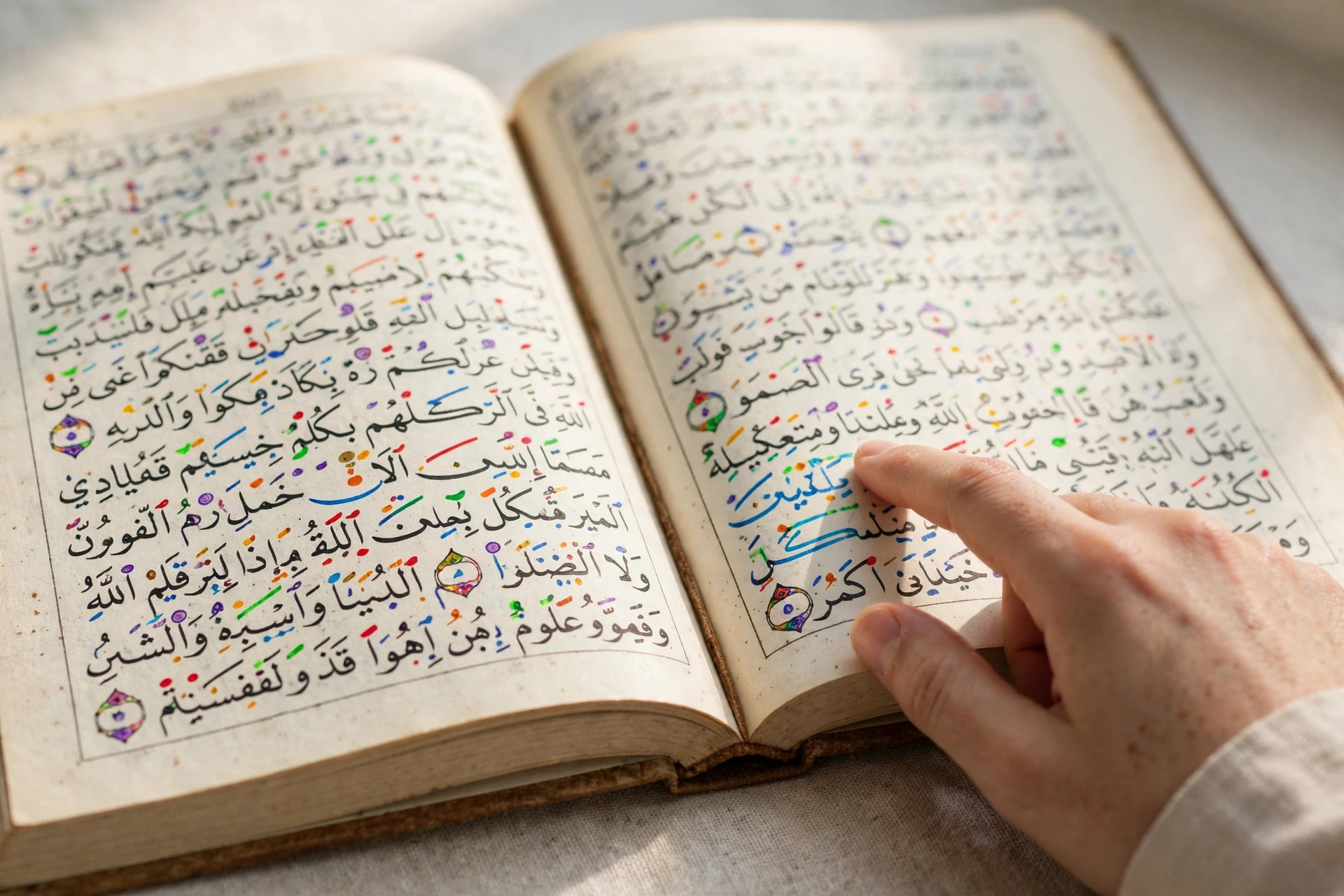
What Is Tajweed and Why Does It Matter?
Tajweed means reciting the Quran the way it was revealed, giving every letter its rights. Each Arabic letter has a place it comes from in the mouth or throat, and tajweed rules tell you exactly how to produce it. Learning tajweed matters because small pronunciation slips can change a word's meaning, and correct recitation is part of honoring the Quran.
Think of tajweed as the pronunciation system of the Quran. Just as English has rules about silent letters, Arabic has rules about how letters sound when they meet each other. These rules were passed down through generations of reciters, and they keep everyone's recitation correct and consistent.
You learn tajweed step by step, not all at once. Most students start with Noorani Qaida to master the letters, then move to Quran Recitation with Tajweed, where a tutor introduces one rule at a time and corrects your recitation live. Students from the USA to the UK follow this same path.
Tajweed Rules for Beginners: Noon Sakinah and Tanween
Noon Sakinah is a noon letter with no vowel, and Tanween is the double vowel mark at a word's end. Your action depends on the next letter. There are four cases: Izhar (say it clearly), Idgham (merge it into the next letter), Iqlab (turn it into a meem sound), and Ikhfa (hide it softly inside the next letter).
This is the first big rule group in any tajweed rules for beginners course, and you will use it on nearly every page. Izhar happens before throat letters like hamza and ha, where you pronounce the noon clearly. Idgham happens before letters like ya and meem, where the noon melts into the next sound.
Iqlab happens only before the letter ba, where the noon turns into a light meem sound. Ikhfa covers the remaining letters, where you hide the noon sound and let a nasal tone flow into the next letter. Your tutor will drill each case with short examples until your tongue does it naturally.
Meem Sakinah Rules Made Simple
Meem Sakinah is a meem letter with no vowel, and it has three simple rules. Before another meem, you merge them with a nasal sound, which is called Idgham. Before the letter ba, you hide the meem softly, which is called Ikhfa. Before any other letter, you pronounce the meem clearly, which is called Izhar.
After Noon Sakinah, this is the next rule group beginners learn, and it is refreshingly short. Only three cases to remember. The merging case is easy to hear: two meems become one long nasal meem sound. The hiding case before ba feels similar to Ikhfa in Noon Sakinah, so it clicks quickly.
The clear case covers everything else, and it is the default. You simply say the meem plainly and move on. Because there are only three rules here, most students master Meem Sakinah within a couple of weeks of guided practice in their Quran Recitation with Tajweed classes.
Madd Rules: When to Stretch a Sound
Madd means stretching a vowel sound longer than normal. The basic natural Madd stretches for two counts, like the long aa, ee, and oo sounds. Other types stretch for four, five, or six counts depending on what follows the vowel, such as a hamza or a letter with sukoon. Your tutor teaches you to count the beats evenly.
You already use natural Madd when you read words with long vowels. The rules simply tell you exactly how long each stretch should be. Stretching too short or too long is one of the most common beginner mistakes, and it is easy to fix once someone points it out.
A helpful trick is to tap your finger lightly for each count while you practice. Two taps for natural Madd, and longer counts where the rules require it. For students who want to go deeper later, the Tajweed Mastery course covers every Madd type in full detail with advanced drills.
Qalqalah: The Echoing Letters
Qalqalah means a slight echo or bounce on five specific letters, qaf, ta, ba, jeem, and dal, when they carry a sukoon. Instead of stopping the sound dead, you let it bounce lightly. It is a small bounce, not a full vowel. Once you hear your tutor demonstrate it, copying the bounce becomes natural within a few practice sessions.
Qalqalah is one of the most satisfying rules to learn because you can hear the difference right away. Say the word with a flat, dead ending, then say it with the little bounce, and the second version sounds alive. That bounce is Qalqalah.
The five letters are easy to remember with the phrase qutb jad, which simply collects them together. Practice them at the ends of words first, where the bounce is clearest, then inside words. Your tutor will check that your bounce stays light and does not turn into an extra vowel sound.
Waqf Rules: Where to Stop and Start
Waqf rules tell you where to stop and where to keep going while reciting. The small signs above words in the mushaf guide you: some mean you must stop, some mean stopping is better, some mean continuing is better, and some mean you may do either. Following these signs keeps the meaning of each verse clear and helps your breathing.
Stopping in the wrong place can break a sentence in half and confuse the meaning, so Waqf signs deserve your attention. The good news is that you do not need to memorize them all at once. Start with the two most common signs, the ones that mean stop here and continue here, and add the rest gradually.
A practical tip is to plan your stops before you start reciting a long verse. Mark two or three comfortable stopping points, recite to the first, take a breath, and continue. This habit makes long verses feel easy and keeps your recitation smooth and meaningful.
How to Practice Tajweed Rules as a Beginner
Practice one rule at a time with short surahs, recite aloud every day, and get a tutor to correct you. Read each new rule, listen to your tutor demonstrate it, copy it slowly, then apply it in five to ten verses. Record yourself weekly and compare with your tutor's recitation. Slow, corrected practice builds tajweed faster than fast, unchecked reading.
The biggest mistake beginners make is trying to learn every rule from a chart before reciting. Tajweed is a sound skill, like music. You learn it by hearing, copying, and being corrected. Fifteen minutes of slow, careful recitation with attention to one rule beats an hour of fast reading where mistakes go unnoticed.
The fastest path is guided practice. In a trial class, a tutor can hear exactly which rules you need and build your lessons around them. Book Free Trial today and start learning tajweed rules for beginners the right way, with live correction in every single class.
Pricing Plans
All prices in USD per month.
| Plan | Price / month |
|---|---|
| 1 class / week | $35 |
| 2 classes / week | $48 |
| 3 classes / week | $65 |
| 4 classes / week | $82 |
| 5 classes / week | $99 |
| Hifz intensive (20 x 60-min classes) | $175 |
30-min 1-on-1 live classes, billed monthly. Free 3-day trial, no credit card. 10% sibling discount.
Frequently Asked Questions
What is the first tajweed rule I should learn?
How long does it take to learn tajweed rules?
Can I learn tajweed rules online?
Do I really need tajweed to read the Quran?
What is the hardest tajweed rule for beginners?
Should kids learn tajweed rules early?
Start Your Free 3-Day Trial Today
No credit card required. Learn with certified 1-on-1 tutors from home.